How We Treat Ear Keloids Safely and Effectively
Do you have a hard lump or thick scar on your ear that just won’t go away?
You may be dealing with a keloid scar—a type of scar that keeps growing well beyond the original injury. Keloids can feel uncomfortable, look unsightly, and in many cases, keep growing unless treated properly.
At Dr Finbar’s Skin Clinic, we offer a comprehensive, evidence-based treatment plan to remove ear keloids and reduce the risk of them coming back.
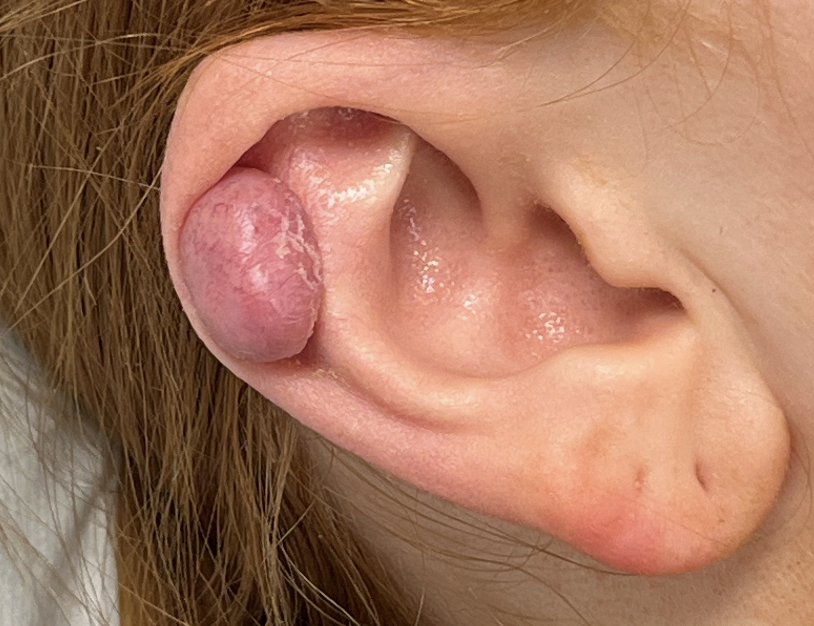
Why Do Keloids Happen?
Keloids form when the body’s wound healing process goes into overdrive. Instead of forming a neat, flat scar, the tissue keeps growing—forming a raised, sometimes itchy or painful lump. This can occur after piercings, cuts, burns, or even spontaneously.
Our 3-Step Treatment Approach
Treating keloids successfully requires more than just removing them. That’s why we use a combined treatment plan that significantly lowers the risk of recurrence.
Here’s what we do:
Careful surgical removal using a precise technique called electro-dissection.
Anti-scar steroid injections to calm the tissue response.
Compression magnets to flatten the scar and keep it flat during healing.
Surgery on its own has a high failure rate — published series report recurrence anywhere from 45% to 100%. Combining surgery with steroid injections and sustained compression brings that down substantially: in the largest published series of ear keloids, 1,436 lesions treated with excision and magnet compression, around 9 in 10 were still clear at 18 months.
What to Expect: Step-by-Step
1. First Appointment
We assess the keloid and discuss your treatment plan.
A small steroid injection is given to start softening the tissue.
You'll receive a link to order special compression magnets for post-op care.
👉 Order your magnets early here
2. Surgery Appointment (2–4 weeks later)
The keloid is removed using electrocautery.
Please remove all earrings, piercings, jewellery, and makeup before your appointment.
3. After Surgery
Use the provided antibiotic ointment twice daily for 7 days.
Avoid swimming, saunas, or hot tubs until the area is fully healed.
Don’t wear earrings or start using magnets until we say it’s safe.
4. Start Compression Magnets (2 weeks post-op)
Begin using magnets once the skin is fully healed.
Wear them every day for 12–16 hours (avoid wearing in bed).
Continue for at least 6 months to help prevent recurrence.
Clean magnets regularly and stop using them if you notice signs of infection.
5. Follow-Up Visits
4 weeks after surgery: Review and second steroid injection.
6 months after surgery: Final check to ensure long-term success.
Total Cost Breakdown
Initial Appointment (includes steroid injection): £200
Surgery: £300
4-Week Review & Second Injection: £180
👉 Total Package: £680
Final Thoughts
Keloid scars can be stubborn—but with the right treatment, they don’t have to be permanent. Our combined approach gives your ear the best chance to heal well, stay flat, and feel comfortable again.
Buy your magnets early.
Stick with the plan.
And remember—consistency is key.
References
[1] Outcomes of Surgical Excision with Pressure Therapy Using Magnets and Identification of Risk Factors for Recurrent Keloids (Park et al., 2011, Plastic and Reconstructive Surgery, 109 citations, DOI: 10.1097/prs.0b013e31821e7006)
[2] Triple Therapy Protocol for Primary and Secondary Auricular Keloids: A Prospective Outcome Evaluation (Datema et al., 2023, Dermatologic Surgery, DOI: 10.1097/dss.0000000000003867)
[3] Earlobe Keloids: A Pilot Study of the Efficacy of Keloidectomy with Core Fillet Flap and Adjuvant Intralesional Corticosteroids (Al Aradi et al., 2013, Dermatologic Surgery, 36 citations, DOI: 10.1111/dsu.12262)
[4] A Primary Protocol for the Management of Ear Keloids: Results of Excision Combined with Intraoperative and Postoperative Steroid Injections (Rosen et al., 2007, Plastic and Reconstructive Surgery, 84 citations, DOI: 10.1097/01.prs.0000279373.25099.2a)
[5] Keloid treatments: an evidence-based systematic review of recent advances (Walsh et al., 2023, Systematic Reviews, 145 citations, DOI: 10.1186/s13643-023-02192-7)
[6] Adjunct Therapies to Surgical Management of Keloids (Berman et al., 1996, Dermatologic Surgery, 227 citations, DOI: 10.1111/j.1524-4725.1996.tb00493.x)
[7] Prevention of Earlobe Keloid Recurrence with Postoperative Corticosteroid Injections Versus Radiation Therapy (Sclafani et al., 1996, Dermatologic Surgery, 196 citations, DOI: 10.1111/j.1524-4725.1996.tb00376.x)
[8] Surgical Excision and Adjuvant Brachytherapy vs External Beam Radiation for the Effective Treatment of Keloids (Hoang et al., 2017, Aesthetic Surgery Journal, 56 citations, DOI: 10.1093/asj/sjw124)
[9] Pressure earring as an adjunct to surgical removal of earlobe keloids (Savion et al., 2009, Dermatologic Surgery, 19 citations, DOI: 10.1111/j.1524-4725.2009.01074.x)
Share this post on:


Copyright © Dr Finbars' Skin Clinic All rights reserved.