How to Use Tretinoin Cream: A GP's Step-by-Step Guide to Getting Started
If you did nothing for your skin but use a retinoid and a daily sunscreen, you'd get over 90% of the benefit that every other product on the shelf is fighting to give you. Here's how to use it properly — and avoid the redness that makes most people quit.
I'm Dr Finbar, a GP with a special interest in dermatology. I prescribe and recommend retinoids almost every day — for acne, and for skin ageing. I also use one myself. I turned 50 in 2024, and after nearly two years of use it has faded some of my sun damage, lifted patchy pigmentation, and helped slow the collagen loss that comes for all of us.
So before we get into the how, let me be honest about the why: I think most skincare routines are overcomplicated and overpriced. Strip it all back and two things do the heavy lifting — a retinoid at night and a sunscreen in the morning. Everything else is a small bonus on top.
This guide is about the strongest everyday retinoid most people will use: tretinoin. By the end you'll know what it does, what to expect, and exactly how to start without your face peeling off in week one.
What tretinoin actually is
Retinoids are a family of ingredients derived from vitamin A. They're among the most heavily researched, most effective ingredients in all of skincare.
There are gentler members of the family — retinol and its relatives — which you'll find in over-the-counter creams. Tretinoin sits at the stronger, prescription end. It was first approved back in 1971 for acne, and researchers quickly noticed it was smoothing fine lines too. It's been around slightly longer than I have.
A quick reassurance if budget matters: studies show the milder retinols, while not quite as potent, produce remarkably similar changes deeper in the skin. So you have options. But if you want the most proven, fastest-acting version, tretinoin is it.
What it does, and why it works
Think of your skin cells as having an instruction manual. Over the years — and especially with sun exposure — that manual gets smudged and the cells start following the wrong instructions. A retinoid helps rewrite it.
It rebuilds the scaffolding. Tretinoin tells your skin to make more collagen and elastin, the fibres that keep skin firm and springy. In one study of sun-damaged skin, biopsies showed an 80% increase in collagen with tretinoin, compared with a 14% decrease in the group using a dummy cream. That's not marketing — that's a skin sample under a microscope.
It fades dark spots. Pigmentation — whether from old spots, sun damage, or melasma — comes from clusters of pigment sitting in the skin. Tretinoin breaks up those clusters so the patches fade gradually and evenly.
It clears acne. It dials down the oil your skin produces, stops pores clogging, calms inflammation, and speeds up healing of active spots. In the UK, adapalene (a gentler cousin) is often the first retinoid we reach for in acne, but tretinoin works well too.
It even has a role against skin cancer. Early cancer cells are, in a sense, confused — they've stopped maturing into the proper, specialised cells they were meant to become, and just keep dividing. Tretinoin helps nudge cells back toward growing up properly, and can prompt some very early damaged cells to die off.
So: fewer wrinkles, fewer dark spots, clearer skin, and a protective edge against sun damage. If it's that good, why isn't everyone on it?
The catch: it gets worse before it gets better
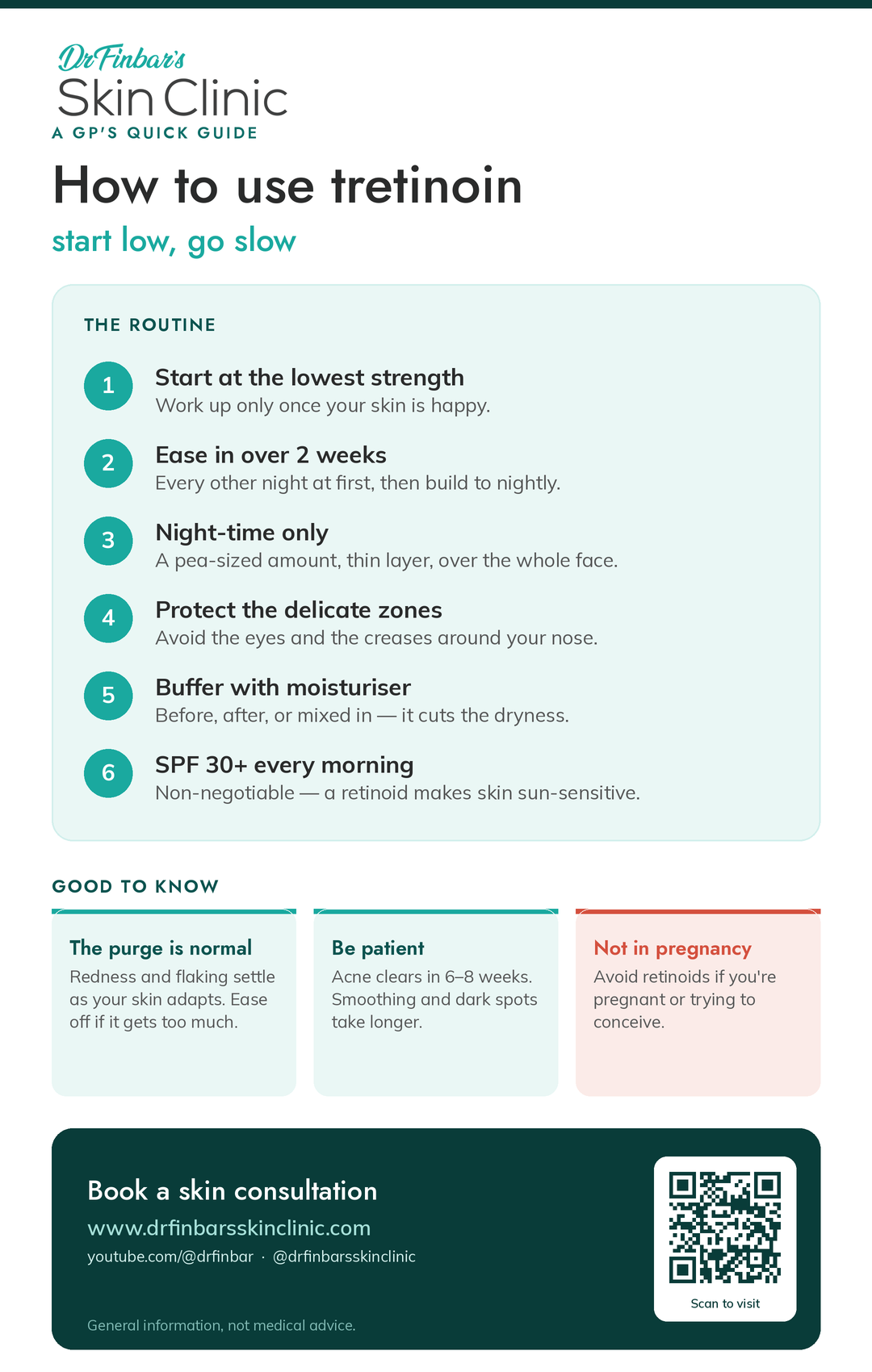
The honest answer is that not everyone tolerates it at first. The most common side effects are redness, peeling, dryness and irritation, especially in the early weeks. Online you'll see this called "the purge." It happens as your skin adjusts to working faster than it's used to.
Two things to know:
- Don't use it in pregnancy. The amount absorbed is tiny, but it isn't recommended, so leave it for now if you're pregnant or trying.
- Be patient. Improvements in acne take six to eight weeks. Anti-ageing and pigmentation changes take longer still. You have to push through the settling-in period to reach the good part.
How to start — without the drama
This is where most people go wrong. They go in hard, get a flaky red face, and give up. Don't. The whole game is start low and go slow.
- Begin with a low strength. Tretinoin comes in several strengths — start at the bottom.
- Use it every other night for the first couple of weeks. Let your skin find its feet before you go nightly.
- If your skin is very sensitive, try short contact first. Apply it, leave it on for two to three hours, then wash it off. Build the time up gradually.
- Always apply it at night. Daylight can break down some formulations, and a retinoid makes your skin more sun-sensitive anyway.
- Wear a broad-spectrum SPF 30 (or higher) every single morning — yes, even on grey days. This isn't optional with a retinoid. It's the other half of the routine.
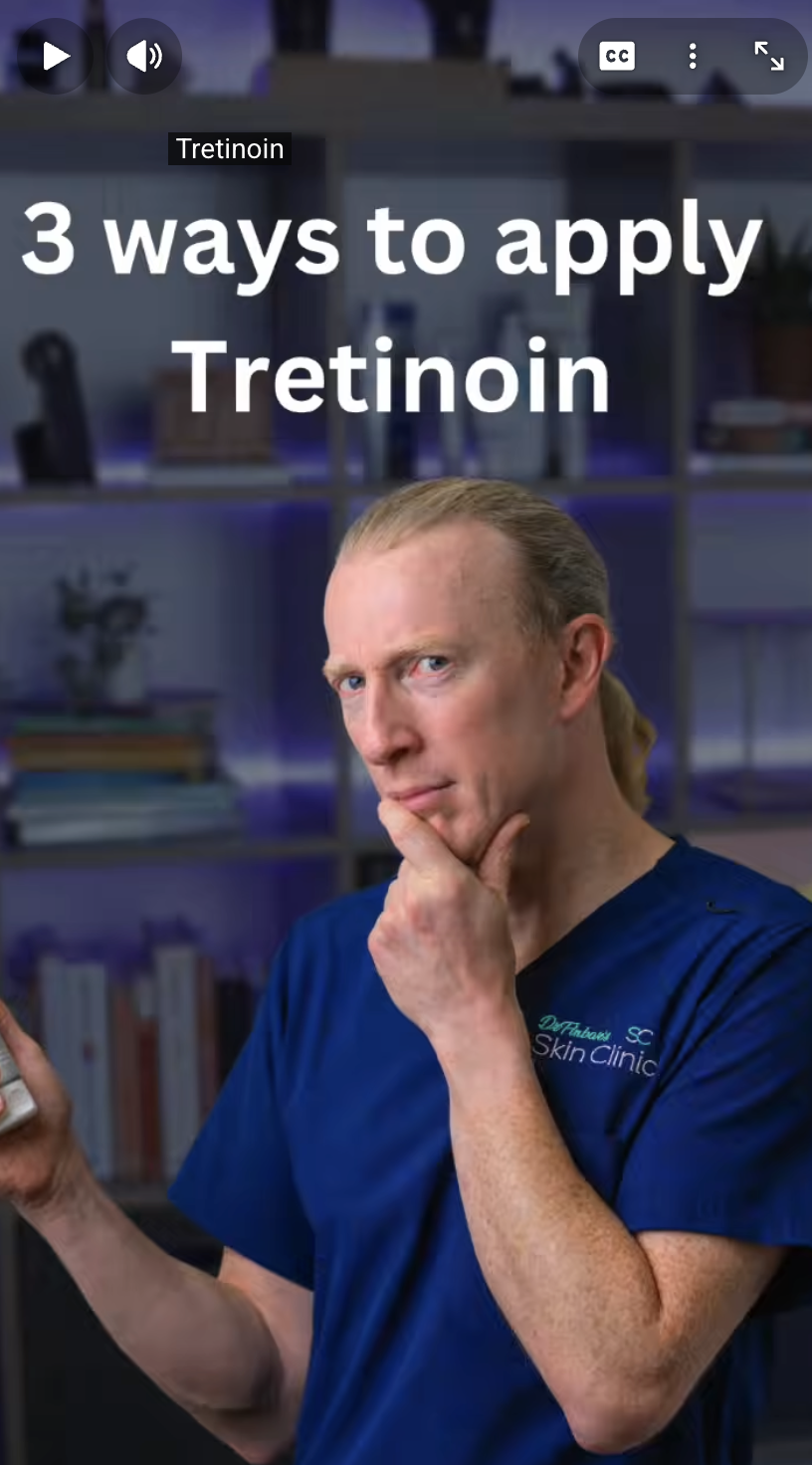
- Buffer with moisturiser. Mixing your retinoid with a moisturiser does not reduce how well it works — the science is clear on that — but it does cut down the dryness and stinging. Apply moisturiser first and let it sink in, then your retinoid; or simply mix the two in your palm and apply together.
- Use a thin layer over the whole face, avoiding the delicate skin around the eyes and the creases of the nose.
- If it gets too much, ease off. Drop back to a few nights a week, or take a short break, then build up again. There's no prize for suffering.
How to actually get hold of it
Tretinoin needs a prescription. If you have acne, your own GP can help, and they'll often give you a combination product — a retinoid premixed with either benzoyl peroxide or a topical antibiotic.
Here's my confession, though: if you walk into your GP and ask for a retinoid to prevent ageing, you may get a slightly blank look. That's not your GP being difficult — it's simply not something we were ever taught to prescribe at medical school. Skin ageing was treated as cosmetic, not medical.
That's why, for my own skin, I use Dermatica — an online subscription service. You answer some questions, send a few photos from your phone, and a clinician tailors a prescription to your skin and your goals, adding other ingredients where it makes sense. It arrives monthly and you can cancel any time. You can get a discount with my code DRFINBAR50 at checkout
https://www.dermatica.co.uk/?promo-code=DRFINBAR50
Some links in this article may earn a small commission at no extra cost to you. I only recommend products and services I use or would genuinely suggest to my own patients.
The bottom line
If you take one thing from this: a retinoid at night and a sunscreen in the morning will do more for your skin than almost anything else you can buy. Tretinoin is the most proven retinoid we have. Start low, go slow, protect your skin in the daytime, and give it time. Your future skin will thank you.
Want help deciding if a retinoid is right for your skin? At Dr Finbar's Skin Clinic we offer GP-led skin consultations and can advise on retinoids, acne, pigmentation and sun damage as part of a proper assessment. Book a consultation at www.drfinbarsskinclinic.com
Connect with Dr Finbar
Website: www.drfinbarsskinclinic.com
YouTube: youtube.com/@drfinbar
Instagram: @drfinbarsskinclinic
Facebook: facebook.com/drfinbarsskinclinic
LinkedIn: linkedin.com/in/drfinbar
This article is for general information and education. It isn't a substitute for personalised medical advice. Please speak to your own doctor or a qualified clinician about your individual circumstances, particularly before starting a prescription treatment.
Share this post on:


Copyright © Dr Finbars' Skin Clinic All rights reserved.